
A rate cut could stimulate demand and help revive industrial activity, without much risk of sparking off inflation again.

Metals, auto and banking shares were in the limelight in this session; the FMCG pack, however, ended lower.
The broader 50-issue NSE Nifty edged up just 0.10 points to close at 10,806.60

RBI watchers are going to be on tenterhooks for the next 3 weeks.

Ideas don't have border controls and visas.
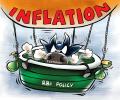
With pricing power of producers unlikely to strengthen and commodities ex-crude oil likely to remain sluggish in the immediate term, the core-WPI inflation may remain sub-zero in the rest of this calendar year.
In the Sensex pack, Vedanta took the biggest hit (5.55 per cent), followed by Tata Motors, SBI, Yes Bank, Bharti Airtel and Infosys, which lost up to 4.50 per cent.
Analysts expect the Reserve bank to cut rates in next monetary policy.

A collapse in global oil prices has unleashed a wave of monetary easing.

Traders are waiting for the earnings season to kick off.

Both across India and the four regions - north, south, east and west - it is found that the absolute prices of a vegetarian thali have decreased significantly since 2015-16 though the price has increased in 2019.

The fundamental debate remains where you stand on the long-term growth question. That is what every investor must monitor and come to their own conclusions, suggests Akash Prakash.

Enter the fireworks city of Sivakasi in Tamil Nadu and you can smell a familiar mix of sulphur, potassium nitrate, aluminium and carbon - familiar because if you've ever burst crackers, say on Diwali or Onam, chances are they were made here. Almost every household used to contribute to India's festive joy by contributing almost 90 per cent of the fireworks made in the country. Before the pandemic, around 300,000 people worked in the industry directly and another 500,000 indirectly. Located 540 kilometres from Chennai, Sivakasi is famous for its fireworks and crackers, along with printing and matches, but is almost a ghost town these days.

But lower growth numbers in the quarters to come may not mean renewed weakness in the economy at the ground level, says Pranjul Bhandari.

The wholesale price-based inflation in February rose to 13.11 per cent on hardening of prices of crude oil and non-food items, even though food articles softened. After two months of mild easing, WPI inflation accelerated in February and remained in double digits for the 11th consecutive month, beginning April 2021. WPI inflation last month was 12.96 per cent, while in February last year, it was 4.83 per cent. The rise in crude oil and natural gas prices after the Russian invasion of Ukraine, beginning February 24, has put pressure on the wholesale price index, even though food articles saw softening across categories of vegetables to pulses to protein-rich items.

The core sector growth for October 2007 declined to 4.5 per cent from 9.9 per cent in the same month last year on account of a slowdown in five of the six sectors that form the core-infrastructure industries index.

Ever since India became a force to reckon with in software services, doing for clients what they want done, the big void that has been constantly talked about is its absence from the space of software products - those over which you own intellectual property rights.

The latest macro-data from India is disquieting

Top losers in the Sensex pack included ICICI Bank, Tata Steel, Vedanta, HDFC IndusInd Bank, Tata Motors, RIL and ONGC -- falling up to 4.45 per cent.

'Retail investors have been selling since the Budget and Foreign Portfolio Investors started selling.' 'Thus far, domestic institutions have picked up the slack, buying enough to keep the major indices from falling off a cliff.' 'However, there has been carnage in smaller stocks and the financial sector has been hit much harder than the major market indices,' points out Devangshu Datta.

Trading through this coming week could be influenced by reactions to events in Europe and the US.

Volatility might continue as the Chinese market is expected to open sharply lower, following a long break

The 30-share Sensex closed up 34 points at 27,831 and the 50-share Nifty ended up 15 points at 8,356.

The Sensex was up 70 points and the Nifty was up 20 points led by SBI on robust Q2 earnings.

Broader market outperformed the benchmark indices with S&P BSE Midcap gaining over 1%

Portfolio returns, say analysts at Morgan Stanley, are more likely to be driven by bottom-up stock-picking rather than top-down macro forces.

The top gainers on the Sensex were Cipla, Bharti Airtel, Maruti Suzuki, Hero Moto & Sesa Sterlite.

Infrastructure and inflation targeting are expected to be top priorities for the new Reserve Bank of India governor, says A V Rajwade.

Tata Steel, SBI, L&T and Sun Pharma advanced 2-5% each.
The inflation rate has been falling at a steady pace, after peaking at 12.83 per cent for the week ended August 16, 2008, mainly due to declining commodity prices. However, on a week-on-week basis, the WPI rose marginally by 0.04 per cent, due to increase in prices of certain articles, including food products like fruit and vegetables, condiments and spices as well as some processed food items.

Expenditure cuts necessitated by slowing revenue growth, weak industrial activity worrisome portents

The WPI inflation stood at negative 2.4% in May 2015, compared with a negative 2.65% in April 2015.

Markets have gone into a tailspin, the Modi govt must revive investment sentiment.

'Instead of doing reforms and restructuring, the present government is busy with the perception that everything is fine and the economy is hunky-dory.' 'Such hollow perceptions are very dangerous for the Indian economy in the long run.' 'The real risk to India is the lack of decent employment opportunities for youth in general and educated youth in particular.'

Despite a massive underperformance at the bourses since the last six months, analysts are turning optimistic on Reliance Industries (RIL). Those at Jefferies, for instance, say that the company is a proxy play for India's consumption growth story. The key catalysts for the stock, according to a Jeffries note, include faster-than-expected market share gain in retail, oil-to-chemicals (O2C) stake sale, recovery in gross refining margins (GRM), potential public listing of Jio and even a possible banking licence going ahead. That apart, analysts feel any tariff hike in Reliance Jio (RJio) - its telecom venture - will also aid performance. With balance sheet adequately de-levered, proceeds from a strategic stake sale in the O2C business will create a sizeable war chest for the company, analysts say.
Given that there has been no negative news flow around Zomato, analysts believe it's time to lap up the shares at lower levels.

The 30-share Sensex ended higher by 177.46 points at 28,885.21 and the Nifty gained 63.90 points at 8,778.30.

The CSI300 index of the largest listed companies in Shanghai and Shenzhen ended at 3,355.16 points and the Shanghai Composite Index at 3,116.35.

Subdued prices of food items like vegetables pulled down retail inflation for the third month in a row to 5.3 per cent in August, within the RBI's comfort zone. While the Consumer Price Index (CPI)-based retail inflation declined to 5.3 per cent in August from 6.69 per cent in the same month a year ago, food inflation dipped at a much faster pace to 3.11 per cent from 9.05 per cent in August 2020. The food inflation was also lower than 3.96 per cent in preceding month of July.

Movement of rupee and crude oil prices will also dictate the trend
 © 2026 Rediff.com - Advertise with us - Disclaimer - Privacy Policy - Sitemap - Feedback - About us - Terms of use - Grievances